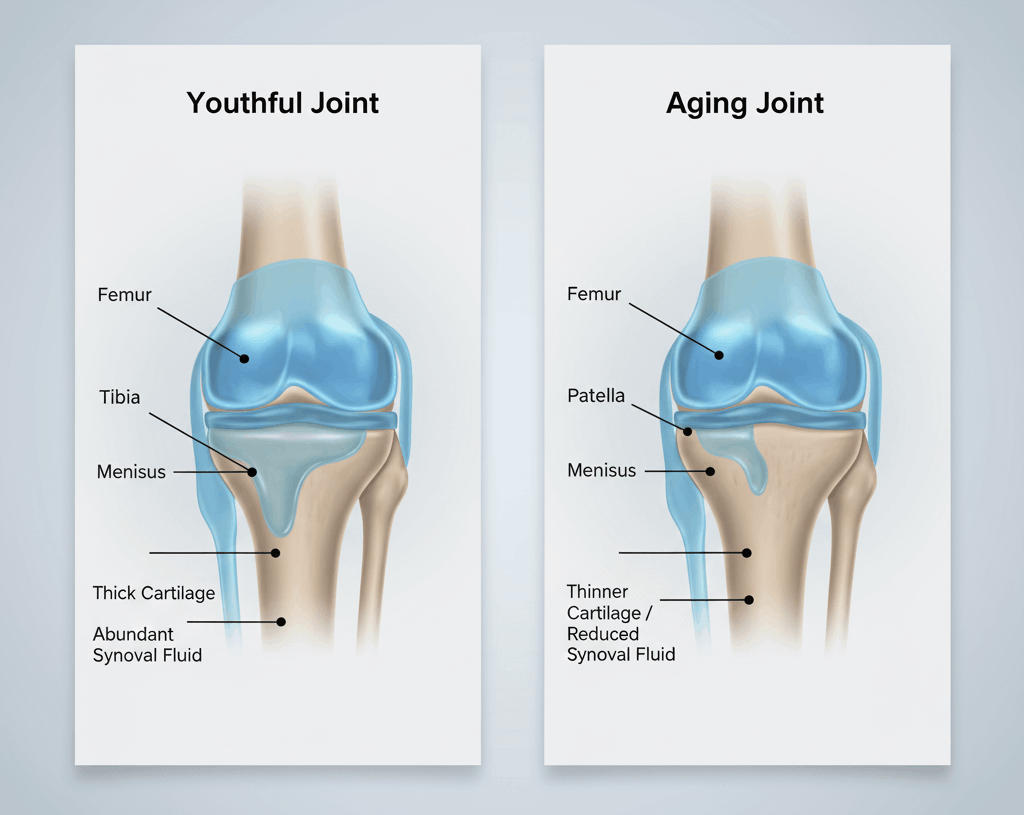
As people grow older, changes in joint comfort and movement are common topics of concern. While these changes are often discussed as a single issue, aging affects joints in multiple, distinct ways. Two of the most important systems involved are synovial fluid, which supports joint lubrication, and joint cushioning, primarily provided by cartilage.
Understanding how aging influences these systems helps explain why joints may feel stiffer over time and why modern joint-health education emphasizes a whole-joint approach rather than focusing on a single structure.
Joints are dynamic structures that adapt to how they are used throughout life. With aging, several biological and mechanical factors change, including tissue elasticity, movement patterns, and recovery capacity.
These shifts can influence:
Importantly, aging does not affect all joint systems at the same rate or in the same way.
Synovial fluid plays a central role in joint lubrication by reducing friction between cartilage surfaces. With aging, the characteristics of synovial fluid may change.
Common age-related influences include:
These changes can contribute to stiffness sensations, particularly when beginning movement after sitting or sleeping.
Movement helps distribute synovial fluid across joint surfaces. As people age, movement patterns often become more limited, which can affect fluid circulation.
Educational resources commonly note that:
This helps explain why many people report feeling better after light movement, even as they age.
oint cushioning is largely provided by cartilage, which absorbs impact and helps distribute load. Unlike synovial fluid, cartilage adapts slowly and has limited regenerative capacity.
Age-related influences on cartilage may include:
These changes highlight the importance of supporting joints through balanced movement and strength.
One important distinction in joint-health education is that changes in lubrication efficiency may be noticed before significant changes in cartilage structure occur.
For example:
This distinction helps explain why early joint discomfort is not always linked to cartilage damage.
As joints age, surrounding muscles play an increasingly important role in supporting movement and reducing unnecessary stress.
Muscle strength and stability help:
Educational approaches often emphasize strength and stability as key components of joint wellness over time.
Aging joints respond to lifestyle habits accumulated over time. Factors commonly discussed in joint-health education include:
These factors influence how joints adapt and how comfortable movement feels with age.
Modern joint-health education increasingly adopts a whole-joint perspective that considers:
This integrated view helps explain why focusing on one element alone may not fully address joint comfort or mobility as people age.
For many individuals, maintaining joint comfort with age involves consistent lifestyle habits supported by education-aligned strategies.
These may include:
Readers interested in learning how nutritional strategies fit into joint-health education may explore information related to joint comfort and mobility support on the
Joint Genesis official website.
Stiffness may be related to changes in synovial fluid circulation, movement patterns, and tissue elasticity rather than structural damage alone.
No. Cartilage changes gradually and varies widely between individuals. Many people experience stiffness without significant cartilage damage.
Movement helps distribute synovial fluid and supports smooth motion, which may temporarily reduce stiffness sensations.
Educational resources emphasize that joint-supportive habits such as movement, strength, and recovery can be beneficial at any stage of adulthood.
Aging affects joint lubrication and cushioning in different but interconnected ways. Changes in synovial fluid circulation often influence stiffness earlier, while cartilage cushioning adapts gradually over time. By understanding these processes, individuals can take a more informed, balanced approach to supporting joint comfort and mobility as they age.
Recommended reading:
What is synovial fluid and why it matters for joint comfort
Daily habits that support smooth movement and joint flexibility
Joint Lubrication vs Cartilage Support — What’s the Difference?
Natural Compounds That Support Joint Comfort — Evidence Overview
Early Signs of Joint Wear Most People Ignore
FDA Compliance
The information on this site is for general knowledge only. It is not a substitute for professional medical advice.
Not Medical Advice: This information is not meant to diagnose, treat, cure, or prevent any disease. It has not been checked by the FDA.
Talk to Your Doctor: Always check with a healthcare professional before changing your diet, exercise, or taking new supplements. This is especially important if you are pregnant, nursing, on medication, or have a health condition.
Affiliate Links: We sometimes use affiliate links. If you buy through them, we may earn a small commission at no extra cost to you. This does not affect our recommendations.
Use this information at your own risk.