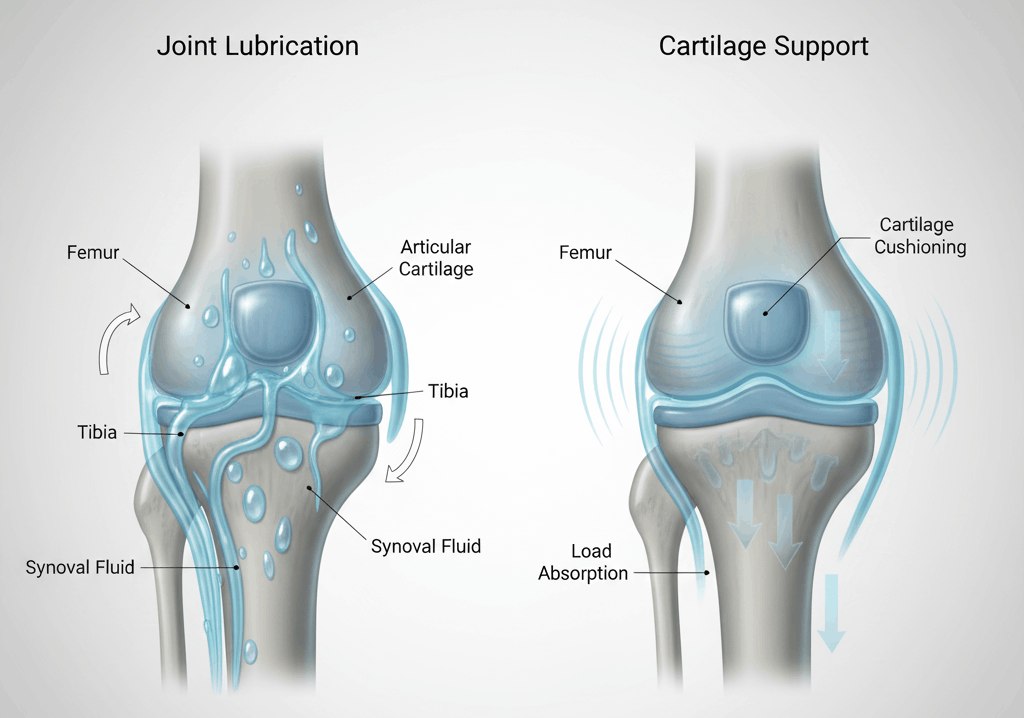
When people think about joint discomfort, stiffness, or reduced mobility, they often assume it all comes from “joint damage” or cartilage wear. In reality, two different—but closely connected—factors influence how smoothly your joints move every day: joint lubrication and cartilage support.
Both play essential roles in movement, stability, and comfort, yet they affect the body in different ways and may respond to different lifestyle strategies. Understanding the difference between them helps explain why some people experience stiffness even when imaging shows minimal wear, while others experience discomfort related to cushioning and structural load.
This article explains how lubrication and cartilage differ, how they work together, how aging may influence both systems, and why modern joint-health education emphasizes a combined, whole-joint approach rather than focusing on only one factor.
Every movable joint in the body depends on two core elements working together:
1) Synovial fluid — the natural lubricating fluid that allows smooth, friction-reduced motion
2) Cartilage tissue — the flexible cushioning layer that absorbs impact and prevents bone-to-bone contact
Although they interact constantly, they serve very different biological purposes.
A person may experience mobility changes related to one, the other, or both at the same time. For a deeper explanation of lubrication, see the pillar article:
[learn more about what synovial fluid is and why it matters for joint comfort] (link this anchor to your pillar page).
Joint lubrication refers to the process that allows joint surfaces to glide smoothly against each other with minimal friction. This function is primarily supported by synovial fluid, a clear, gel-like liquid found inside synovial joints such as the knees, hips, shoulders, and fingers.
Key characteristics of joint lubrication:
Synovial fluid functions much like natural joint oil. Under normal conditions, it forms a thin protective layer between moving structures, helping movement feel smooth instead of rough or resistant.
However, multiple factors may influence how effectively this lubrication system works over time, including:
People sometimes describe sensations associated with lubrication decline as:
These experiences are often related more to fluid dynamics and movement circulation than to structural cartilage loss.
When discussing lubrication in other pages on your site, use internal anchor text such as “how synovial fluid supports smooth, comfortable movement” and link back to the pillar page.
While lubrication allows surfaces to glide, cartilage protects those surfaces from impact and mechanical stress.
Cartilage is a smooth, flexible, and resilient tissue that:
Cartilage does not receive the same direct blood supply as most other tissues. Instead, it relies heavily on nutrient exchange through surrounding joint fluid and movement.
Over time, normal wear, posture mechanics, repetitive movements, and increased load may influence cartilage:
This is why balanced movement, stability training, and load-management habits are central topics in modern joint-health guidance.
In future articles, link phrases such as
“how aging affects synovial fluid and joint cushioning” to your aging-focused supporting article.
Although they work together, lubrication and cartilage support serve different purposes.
Joint Lubrication:
Cartilage Support:
This distinction explains why someone may experience stiffness or discomfort even when cartilage appears intact — lubrication efficiency can change independently of cartilage structure.
Both systems matter. Addressing one without considering the other may lead to incomplete support strategies.
Many people assume that joint stiffness automatically signals cartilage wear. However, this is not always the case.
Stiffness can be influenced by:
In these cases, movement may restore comfort by redistributing synovial fluid, even though cartilage remains unchanged.
This is why stiffness that improves with light activity is often discussed in relation to lubrication rather than structural damage.
A common misconception is that every mobility issue must indicate structural wear. In reality, many adults experience stiffness symptoms driven by lubrication and circulation changes rather than cartilage structure.
Common examples include:
These experiences are frequently associated with:
In these situations, movement exposure, light activity, and mobility habits are often emphasized within joint-health education.
Add a contextual cross-link here to your lifestyle article using anchor text such as:
“daily habits that support smooth movement and joint flexibility.”
Aging does not affect every joint system equally, and the experience varies widely between individuals. However, common age-related patterns discussed in joint-health research include:
These influences may affect lubrication before significant cushioning changes appear, which is why maintaining mobility remains a primary focus throughout adulthood.
Add a cross-link to your aging-focused article using anchor text such as
“how aging affects synovial fluid and joint cushioning over time.”
Movement is essential for healthy joint lubrication.
When joints move:
Low-impact activities such as walking, cycling, or mobility exercises are commonly discussed in joint-health education as ways to encourage natural lubrication without excessive stress.
In contrast, prolonged immobility may limit fluid distribution and contribute to stiffness sensations.
Cartilage support typically becomes a more prominent focus in situations involving:
In these contexts, evidence-aligned guidance often emphasizes:
Add an internal link here to your “early signs of joint wear” article using anchor text such as
“subtle early signs of joint wear most people ignore.”
Earlier models of joint support often emphasized cartilage alone. Today, a more integrated understanding recognizes that mobility quality, lubrication efficiency, and cushioning health are interdependent.
Supporting only one factor in isolation may overlook key contributors such as:
A whole-joint approach emphasizes function, longevity, and sustainable movement, not short-term outcomes.
Although they serve different functions, lubrication and cartilage operate as an integrated system:
This interconnected relationship is why modern joint-education models promote a dual-support perspective rather than emphasizing only one factor.
At an appropriate point in the article, include a neutral contextual reference to your product page using anchor text such as:
“learn more about a lifestyle-focused approach to supporting smooth, comfortable movement”
and link this to https://jointjenesis.com/
No. Joint lubrication refers to fluid-based movement support, while cartilage health refers to structural cushioning. Both are essential but serve different roles.
Light movement helps distribute synovial fluid across joint surfaces, which can improve lubrication and reduce friction-related stiffness.
Yes. Changes in lubrication, muscle tension, or movement patterns can influence comfort even when cartilage structure appears normal.
Yes. Lubrication supports smooth motion, while cartilage cushioning absorbs load. Both systems work together to support comfortable movement.
No. Joint stiffness is often related to reduced synovial fluid circulation, prolonged inactivity, or muscle tightness rather than structural cartilage damage.
Joint lubrication and cartilage support are not the same thing, but they are equally important. Lubrication focuses on smooth movement, while cartilage provides structural cushioning. Understanding the difference helps explain common joint sensations and supports a more balanced, informed approach to long-term mobility and comfort.
Recommended reading:
What is synovial fluid and why it matters for joint comfort
Daily habits that support smooth movement and joint flexibility
How aging affects synovial fluid and joint cushioning
Natural Compounds That Support Joint Comfort — Evidence Overview
Early Signs of Joint Wear Most People Ignore
FDA Compliance
The information on this site is for general knowledge only. It is not a substitute for professional medical advice.
Not Medical Advice: This information is not meant to diagnose, treat, cure, or prevent any disease. It has not been checked by the FDA.
Talk to Your Doctor: Always check with a healthcare professional before changing your diet, exercise, or taking new supplements. This is especially important if you are pregnant, nursing, on medication, or have a health condition.
Affiliate Links: We sometimes use affiliate links. If you buy through them, we may earn a small commission at no extra cost to you. This does not affect our recommendations.
Use this information at your own risk.