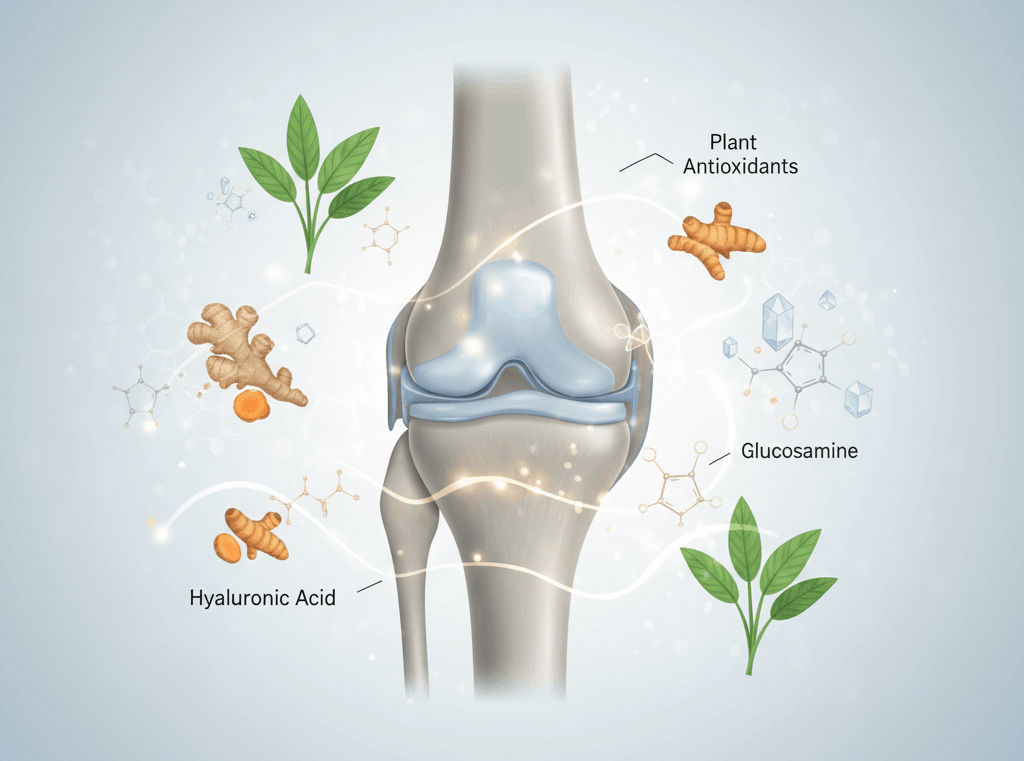
Joint comfort is influenced by a combination of movement patterns, joint structure, muscle support, and biological processes that help joints adapt to daily use. In addition to lifestyle habits such as activity and recovery, many people explore natural compounds that are commonly discussed in joint-health education for their supportive roles.
This article provides an evidence-informed overview of natural compounds frequently referenced in discussions about joint comfort, mobility, and smooth movement — without making treatment claims or promoting specific products.
Joint comfort is not determined by a single factor. It reflects how well multiple systems work together, including:
Natural compounds are typically discussed as supportive elements that may help maintain these systems as part of a broader wellness approach.
Certain naturally derived compounds are researched because they participate in normal physiological processes related to:
Importantly, these compounds are not mechanical fixes. Their role is generally described as supporting the environment in which joints function rather than altering joint structure directly.
Hyaluronic acid is a naturally occurring substance found in connective tissues and synovial fluid. It is widely studied for its role in maintaining fluid viscosity and lubrication.
Educational discussions often highlight that hyaluronic acid:
Its relevance to joint comfort is commonly framed around lubrication efficiency rather than structural cushioning.
Glucosamine is a naturally occurring compound involved in cartilage metabolism. It is frequently referenced in joint-health literature due to its role in normal cartilage structure.
Research discussions typically focus on:
Glucosamine is often discussed in the context of cartilage support rather than lubrication.
Chondroitin sulfate is another compound naturally present in cartilage tissue. Educational resources often describe it as contributing to cartilage’s ability to resist compression.
Its relevance to joint comfort is commonly framed around:
Like glucosamine, it is discussed as part of cartilage-supportive strategies rather than fluid-based lubrication.
Oxidative stress is one factor studied in relation to joint tissue aging and comfort. Certain natural compounds are researched for their antioxidant properties, which help support cellular balance.
Examples often discussed include:
These are generally positioned as supporting overall joint environment balance rather than acting directly on joint structures.
Various plant-derived compounds have a history of traditional use in wellness practices related to movement and comfort. Modern research often explores these compounds for their bioactive properties.
Educational discussions may reference:
Such compounds are typically framed as complementary options within lifestyle-based approaches.
Not all research on natural compounds is equal. Joint-health education emphasizes the importance of:
This is why natural compounds are best viewed as context-dependent supports rather than standalone solutions.
Modern joint-health education increasingly highlights a whole-joint perspective that includes:
Natural compounds are typically discussed as one element within this integrated framework, supporting joint comfort alongside daily habits.
Some individuals explore nutritional supplements that combine multiple natural compounds associated with joint health as part of a daily wellness routine.
These formulations are generally positioned to:
Readers interested in how nutritional strategies fit into joint-health education may review information related to joint comfort and mobility support on the
Joint Genesis official website.
No. Natural compounds are discussed as supportive elements within wellness routines, not as medical treatments or cures.
Most are studied in the context of long-term use and consistency rather than immediate effects.
No. Educational resources consistently emphasize that movement, strength, and lifestyle habits remain foundational for joint comfort.
Different compounds support different aspects of joint physiology, which is why formulations often reflect a whole-joint approach.
Natural compounds discussed in joint-health education are best understood as supportive contributors to joint comfort rather than standalone solutions. When combined with consistent movement, strength, hydration, and recovery habits, they may help support smooth movement and mobility as part of a balanced wellness approach.
Recommended reading:
What is synovial fluid and why it matters for joint comfort
Daily habits that support smooth movement and joint flexibility
How aging affects synovial fluid and joint cushioning
Joint Lubrication vs Cartilage Support — What’s the Difference?
Early Signs of Joint Wear Most People Ignore
FDA Compliance
The information on this site is for general knowledge only. It is not a substitute for professional medical advice.
Not Medical Advice: This information is not meant to diagnose, treat, cure, or prevent any disease. It has not been checked by the FDA.
Talk to Your Doctor: Always check with a healthcare professional before changing your diet, exercise, or taking new supplements. This is especially important if you are pregnant, nursing, on medication, or have a health condition.
Affiliate Links: We sometimes use affiliate links. If you buy through them, we may earn a small commission at no extra cost to you. This does not affect our recommendations.
Use this information at your own risk.